FAQs
1. What type of resident profile do you expect to have in your communities?
Under the Fair Housing Act as amended we will be catering for 55 years plus in respect of 80% of the properties in each project.
2. How will healthcare services be delivered if residents need this?
From links with a full range of local healthcare providers.
3. You have mentioned a number of different locations in America. Where do you expect to start?
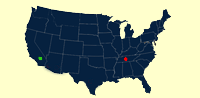
The company is most advanced in its land search and (having carried out extensive market studies) in Florida and intends to start the programme with a key acquisition in Nashville.
4. What is the main obstacle to achieving this development programme?
The main problem is securing sites of the right size (5 – 35 acres), in the right location, with planning permission and at the right price. We have looked at a number of different sites with inherited ownership problems in that the owners were indebted to financial institutions for far in excess of the true market value of the sites therefore making any sensible negotiations difficult because of the disparity in expectations.
5. How do you intend to finance the first and following developments?
The company is funded debt-free to date and is currently raising fresh capital to carry out and execute the first acquisition near Nashville. RCC has a wide network of American and International financing contacts.
6. What bonding arrangements will be in place for each development?
Under American law at least one-third of the properties in the development must be formally reserved before the developer can obtain a bond, roughly equivalent to the construction value. The company will ensure that it deals with reputable construction companies and they in turn have the relevant insurance in place. It is anticipated that the company's banking provider of development finance will also offer mortgages on extremely favourable terms to potential purchasers.
7. How many of the services are obligatory in terms of payment? How many are 'à la carte'?
The obligatory (basic) services relates to typical service charges provided in a community levied by the Home Owners’ Association such as boundary security, refuse collection, general insurance, gardening, landscape maintenance. The basic services also provide the use of amenity buildings such as the club house. À la carte, or optional, services are, of course, choice based and range from meals purchased through to third party care and other services. The objective is to keep the HOA monthly expenditure to a minimum whilst ensuring top class services are delivered.
8. Will it be possible to choose and have input in the design of a home once reserved?
Yes, apart from the structural layout it will be possible to have significant input in the design of the interior of one’s property within reason (including kitchen and bathroom fittings) and even the choice of sustainable energy supplies. RCC will maintain a design office with a leading designer in each project alongside the property sales manager.

9. If RCC has developments in more than one location would it be possible to switch with other owners on a seasonal basis?
Yes, part of the club membership will include a members' exchange programme for long or short periods or even permanent exchanges as members’ wish.
10. What is the cost of HOA membership?
Any purchaser will automatically be a member of the HOA. Furthermore any person who is considering purchasing in our schemes can join our own “loyalty club” which will offer a priority reservation in new projects or re-sales in existing projects.
11. Why is there an explanation of the Active Adult Retirement Community Concept?
This is really to give interested parties an idea how this sector has evolved in the United States so as to see what may be most suitable for their requirements whilst considering options.

These will involve golf as we are currently looking at project adjoining golf courses but will be as diverse as a yacht club and it is intended to have extremely well-equipped marina services. There would be an emphasis on any suggested affinity groups such as fishing, classic car enthusiasts, bridge, cooking, reading, hunting etc. Basically any demand will be catered for by the activities director. In addition to a car share scheme there will be scheduled day trips as required; these will normally be to the local large town or urban conurbation.
13. Do you expect this to be an American only project?
Not at all. It is anticipated that around 50% of the potential residents will be American with a further 25% comprising Canadians and the balance perhaps from South America and Europe.